- PhilaScan
- Guides
Inherited a stamp album? What to do next
An inherited stamp collection can be a box of everyday stamps, a carefully built life's work, or something in between. The most useful thing you can do at first is slow down: handle it carefully, keep it together and find out what it actually is.
Inherited a stamp collection? Start by changing nothing
When an inherited stamp collection arrives, it is tempting to start pulling stamps out, sorting them into piles or soaking them off paper. Resist that for now. Most damage to old collections happens in the first days after they change hands. Stamps are torn when lifted from hinges, faded or ruined in water, and mixed up so that useful context is lost. Nothing in an album gets worse by waiting a few weeks while you learn what you have.
A realistic expectation helps too. Many family collections consist mainly of common stamps, which is entirely normal: stamp collecting was a hugely popular hobby, and the stamps people could buy or save are the same ones millions of others saved. Some collections, however, contain scarce stamps, interesting postal history or decades of careful work. You can only tell which kind you have by looking calmly.
Keep the album and its order intact
The way a collection is arranged is part of its value. Pages ordered by country and year, notes in the margins, dealer envelopes, old purchase receipts and handwritten lists can tell an expert what the collector was aiming for and where the better pieces are. Keep albums, stockbooks and loose material together, do not remove stamps from their mounts, and do not throw away envelopes or scraps of paper with writing on them until someone knowledgeable has seen them. If there are several albums, number them in pencil on a slip of paper in each, so the order can always be restored.
Look for covers, postcards and old letters
Envelopes, postcards and letters that went through the post (collectors call them covers) can be worth more than the stamps on them. Postmarks, routes, rates, censor marks and unusual destinations all interest postal history collectors. Keep stamps on their covers, and do not cut or soak them off. The same applies to stamps on piece, small fragments of envelope with the postmark still tied to the stamp. Old family correspondence also has personal value that is easy to lose by sorting only for stamps.
How to handle and store old stamps
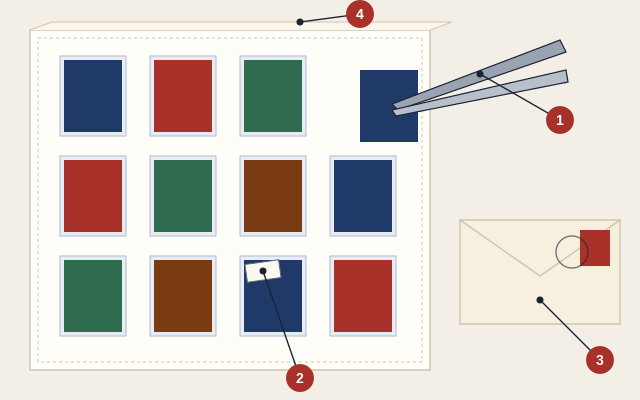
- Use stamp tongs, not fingers or household tweezers with sharp tips. Tongs have smooth, flat ends that do not damage the paper. If you must touch anything, have clean, dry hands.
- Store albums flat or upright, fully supported, never leaning or under heavy objects, so pages and spines do not warp.
- Keep them dry, dark and at room temperature. Attics, cellars and garages bring damp, heat and temperature swings, which cause toning, foxing and stuck-down gum. Direct sunlight fades colours.
- Avoid rubber bands, sticky tape, paper clips and PVC sleeves. Rubber perishes and stains, tape leaves residue, and soft PVC plastics can damage stamps over time.
- Keep interleaving sheets between pages where the album has them; they stop facing stamps from sticking together.
Get an overview of what you have
Before thinking about money, make a simple inventory. You do not need to list every stamp; a page of notes is enough:
- Countries and regions: one country in depth, a worldwide album, or a mixture?
- Periods: mostly nineteenth-century, early twentieth, or recent decades?
- Mint or used: unused stamps with gum, used stamps with postmarks, or both?
- Format: printed albums, stockbooks, envelopes of loose stamps, covers, sheets?
- Anything that looks special: stamps kept separately, in protective mounts, with certificates, or mentioned in notes.
Photograph each album page; it documents the collection's state and helps when you ask for opinions. Identifying a handful of stamps also teaches you a lot quickly. Our guide on how to tell if a stamp is valuable explains what experts look at, from centering and gum to cancels and errors, and how to measure perforations covers one of the key details for identifying varieties.
What is the stamp album worth?
A stamp catalogue gives figures for individual stamps, but treat them as a rough guide, not as what you will be paid. Catalogue figures assume a certain condition, and many stamps in an album will not match it. To get a realistic idea of stamp album value:
- Look up a few of the most promising stamps in a catalogue to see the general range.
- Ask a philatelic society or local stamp club. Members are often happy to look at a collection and give honest, independent advice.
- Show it to stamp dealers and auction houses that handle stamps. Many will give a free first assessment.
- For individual stamps that may be valuable, ask about an expert certificate before selling.
Modern mint stamps deserve a special note. Large quantities were saved, so they often sell at or below face value. In some countries stamps in the current currency can still be used as postage, while stamps in former currencies usually cannot.
Selling responsibly
If you decide to sell, a few habits protect you from regret:
- Get several opinions before agreeing to anything, ideally from people who do not know what the others offered.
- Be cautious with instant cash offers, especially unsolicited ones or buyers who come to your door and want an answer the same day.
- Expect dealer buying prices to be well below catalogue figures. A dealer has to sort, store and resell the material and carry the risk, so this is normal and not a sign of bad faith.
- Know that whole collections are often sold as one lot, at auction or to a dealer. Splitting out the few better stamps can make sense, but only after advice, because it can make the remainder harder to sell.
- Online marketplaces can work for individual pieces but take time, photos and accurate descriptions.
What to do with old stamps if you keep them
Not every inherited collection needs to be sold. Some families keep an album as a memento, others pick up where the collector left off. Stamp collecting is still an active hobby with clubs, exhibitions and societies for almost every country and theme, and an inherited album is a natural starting point. If the collection is modest and nobody wants to keep it, philatelic societies, youth stamp clubs and some charities welcome donations of stamps, so even common material can find a good home.
Identify your stamps with PhilaScan
Photograph a stamp to see its country, year, issue, perforation and watermark, with a value tier. Your first identification is free; value estimates by condition come with PhilaScan Pro. Estimates, not appraisals.
Coming soonon the App Store